


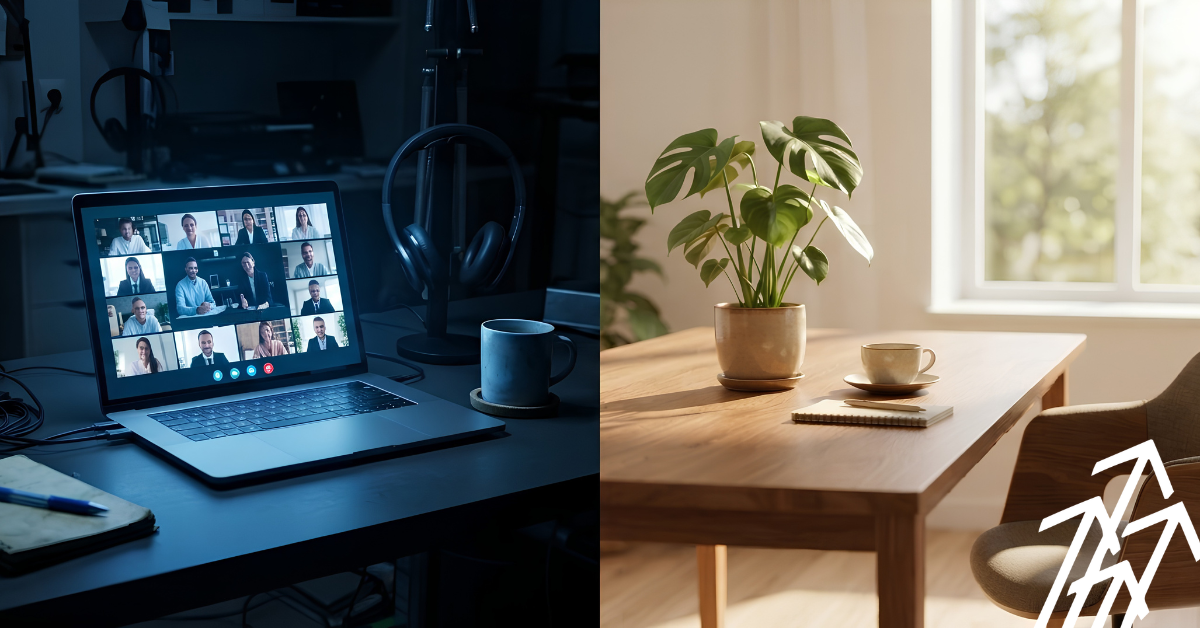
Staring at a screen for eight hours a day doesn't just mean physical fatigue, but a deep cognitive overload known in organizational psychology as the "mirror effect" and "presence anxiety." When audio-video technology fails, our brains consume massive amounts of energy just to compensate for the lack of non-verbal cues. In the current corporate environment, the shift to hybrid working has brought a series of flexibility-related benefits, but it has turned company meeting rooms into true technological "compromise rooms."
For business leaders, chief operating officers, and IT departments, understanding how the design of collaboration spaces directly impacts employee productivity and mental health has become an absolute strategic priority.
Why classic meeting rooms fail the human psyche
Fundamental research conducted by Professor Jeremy Bailenson, founding director of the Virtual Human Interaction Lab at Stanford University, has revealed the exact reasons why virtual meetings mentally exhaust us differently than a physical interaction:
- The absence of real eye contact: in a normal videoconferencing room or on a laptop, making eye contact is practically impossible because the camera lens and the interlocutor's image are placed in different spots. Psychologically, this creates a constant state of dissonance and a subconscious lack of trust, as the brain senses that something is wrong with the social dynamics.
- The perpetual mirror effect and self-monitoring: most platforms constantly display your own image on the screen like a small mirror. In real life, no one follows you around with a mirror while you talk, negotiate, or make decisions. This constant self-analysis generates high levels of critical stress and emotional fatigue.
- Spatial asymmetry and the grid of squares: when you see dozens of people crammed into a grid of equal screens, the brain loses its natural hierarchy of attention and the ability to read the subtle dynamics of power or interest in a business meeting.
- Auditory fatigue through distortion: when sound has a subtle echo or feedback caused by poorly calibrated microphones in a glass room, the auditory cortex works in emergency mode to decode words, leaving zero resources for strategic and creative thinking.
The shift to immersive telepresence ecosystems
The solution to combat these dysfunctions is not to reduce the number of meetings, but to radically change the physical and technological infrastructure through which they happen. According to industry analyses published on benchmark platforms such as AVIXA (The Audiovisual and Integrated Experience Association), integrating enterprise-grade audio-video technologies eliminates cognitive barriers and restores the naturalness of human interaction through the following principles:
- The illusion of physical proximity through life-size screens: remote participants are projected at their real-life size, allowing the brain to activate the same mechanisms of empathy and body language reading as in a face-to-face meeting.
- Spatial audio and acoustic voice localization: in an advanced AV ecosystem, a colleague's voice is heard precisely from the direction where they are positioned on the screen. This spatial clarity massively reduces the brain's cognitive effort of associating sound with the person speaking.
- Reducing the fear of speaking up: in poorly equipped rooms, participants hesitate to speak for fear of being interrupted or not being heard clearly. A properly calibrated audio-video system creates an organic conversation flow, essential for fast board-level decisions.
The impact on business decisions and talent retention
The cognitive comfort of employees and the executive team is not an interior design or HR whim, but a direct variable of profitability and the quality of strategic decisions. Organizations that invest in an immersive audio-video infrastructure report increased efficiency in complex negotiations, a lower drop-out rate during long meetings, and a significant reduction in professional burnout.
A company that modernizes its workspaces with cutting-edge technologies sends a strong signal of organizational maturity while protecting the mental health and cohesion of its team.
What is the difference between an ordinary meeting room and an immersive telepresence space?
A traditional meeting room uses consumer-grade equipment (standard webcams, a large display, and a generic soundbar), which creates a fragmented and exhausting experience. In contrast, immersive telepresence integrates life-size screens, specially designed ergonomic furniture, smart cameras with auto-framing, and spatial audio systems, completely eliminating the barrier-of-the-screen feeling.
How does audio-video quality influence employee fatigue (Zoom fatigue)?
Studies show that poor sound and rigid two-dimensional images force the brain to overwork the visual and auditory cortex to compensate for the lack of non-verbal cues. This overload leads to cognitive exhaustion, a drop in concentration, and decisions made under chronic stress.
Why is spatial audio important in the corporate environment?
Spatial audio distributes participants' voices according to their physical or virtual position on the screen. This mimics the way we hear in real life, allowing the brain to follow discussions with minimal effort and eliminating the confusion generated when multiple people speak at the same time in a video conference.
Are these solutions compatible with the platforms the company already uses (Teams, Zoom, Google Meet)?
Yes. Modern enterprise AV ecosystems are natively certified for the main collaboration platforms on the market. This means users can join regular meetings with a single click, while enjoying a radically superior quality of experience without the need for additional training.
How does the finance department justify such an investment in AV technology?
The investment is justified by reducing costs and time wasted on unnecessary travel, increasing decision-making speed among the board, and eliminating downtime caused by technical failures or inefficient meetings in poorly equipped rooms.

Comments